8 min read
Map the Light on Your Balcony Before You Plant
A pencil, a clear day, and a few observations at the height of your future plants can tell you more than a compass alone.
On this page
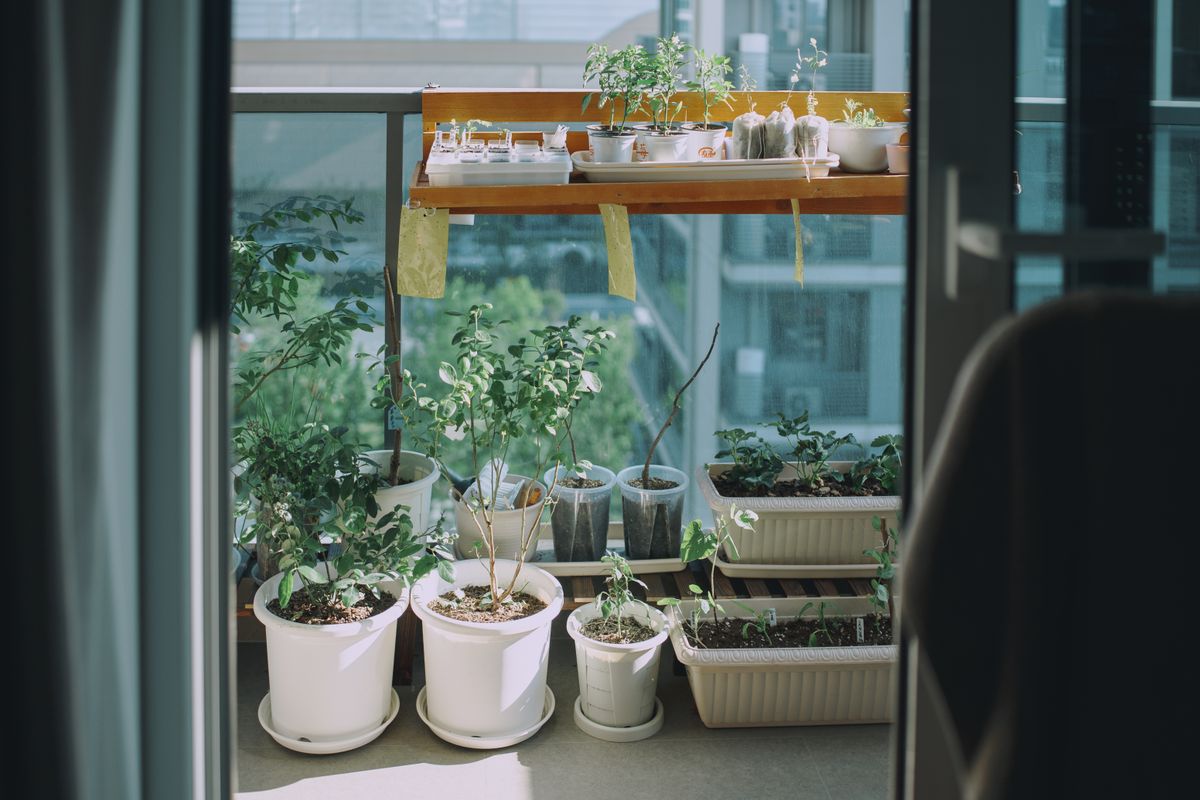
At breakfast the whole balcony is bright. At lunch the upper railing is still sunny but the floor is in shadow. By the time you get home there is one hard rectangle of sun under the drainpipe, and it slides behind the neighboring building before dinner. Which of those moments should determine what you buy? All of them. A useful map follows the moving light and shows where a plant's leaves will actually be. It also gives you somewhere to put a pot when the weather, or the plant, disagrees with your first plan.
Draw the balcony as it exists
Use an overhead sketch and give it enough detail that you can find the same spot tomorrow. Mark the door, railing, walls, posts, the lip of any roof above you, and the places where large furniture has to stay. Include anything across the street that throws a shadow, even if it seems too far away to matter. Mark the path to the door and leave it free. A planting plan that makes you step around a tub with a watering can several times a week is unlikely to survive the summer.
Pick four to six observation points. A good set might include the outside corner near the rail, the center of the floor, the wall beside the door, and a shelf at shoulder height. Mark the height as well as the place. A plant on a shelf can rise into a band of sunlight that never reaches a pot below it. Conversely, putting a short seedling deep inside a decorative cachepot can remove the very advantage a shelf would otherwise provide.
The balcony's orientation is still helpful. A compass tells you which direction the sun is likely to come from, and whether the shadows on your map are mostly cast by the building or by obstacles around it. But record your observations first. An east facing balcony across from a taller building may receive far less direct sun than a west facing balcony in the same block. The word east cannot tell you when the other building's shadow moves.
Follow the edges of the shadows
Choose a clear day when you can check every hour or two, from soon after sunrise until the balcony loses the last direct light. At each check, write the time and shade the area with a pencil. If you cannot stay home, make a morning and evening sketch on a workday and fill in the middle on a weekend. One picture from the same position at each check makes it easier to review confusing transitions later.
Direct sunlight usually gives a hand held above a sheet of paper a sharp shadow. Bright indirect light gives a soft or faint one. Dappled light has separate patches that move, such as under a tree. The distinction is useful even when you do not plan to calculate anything. A pale wall might make a sheltered corner pleasant to sit in without providing the energy a fruiting crop needs. A metal railing might reflect a concentrated strip of light onto leaves for less than an hour; note that hot strip separately from the dependable sun.
When a point changes between checks, record a range rather than a spurious exact number. For example, a pot position that was sunny at nine and ten but shaded at eleven got at least an hour around that period. A second observation at ten thirty can narrow it down if the choice between two pots depends on it. Do not add up the readings themselves as hours. Consecutive observations are evidence about the interval between them, while an isolated reading may have caught a brief opening in the clouds or a gap between buildings.
Give each spot two scores
Start with a direct sun estimate. As a working guide, many fruiting vegetables perform best with about six or more hours of direct sun, while leafy crops and herbs such as parsley or mint can be worth trying where they get a few hours or very bright shade. Species, variety, heat, and latitude all change the result. A short stretch of punishing afternoon light can dry a pot faster than a longer stretch of cool morning light. Lettuce that survives in a warm sunny corner may still become bitter or bolt earlier than lettuce with some afternoon protection.
The second score is exposure. Write three words next to each point: something about wind, something about reflected heat, and something about rain. For example, "gusty, cool, exposed" is an entirely different growing place from "calm, hot, dry," even if both receive four hours of sun. Check the wall and paving at the hottest time with your hand hovering nearby rather than touching surfaces that could burn. If warm air pours out of a vent or cold air funnels down an alley, add that to the map. On a rainy day, look at which parts of the floor remain dry. A roof can leave the garden thirsty even after a soaking storm.
Look at how water leaves the area before placing any containers. Find the drain and keep it clear. In a shared building, ask about rules for containers, drainage, and railings. A wet pot can be much heavier than its empty weight suggests, and a planter that hangs beyond a balcony edge can fall. Use stable freestanding containers inside the railing, or purpose made hardware permitted by the building. Avoid concentrating heavy pots in one corner if you do not know the balcony's load limits.
Choose plants by their job
With a single sunny point, give it to the plant that needs the most light to do what you want. A compact tomato grown for fruit takes priority over a pot of herbs grown for leaves. Put leafy crops nearer the boundary between sun and shade, where they can catch a gentler portion of the day. On a balcony with no sustained direct sun, trial a couple of shade tolerant ornamentals suitable for your temperatures before filling the floor with expensive fruiting plants.
Fit the mature plant, not the nursery pot. A tomato trained upright on a support may shade a planter behind it by midsummer. A vine near the side that receives the most light can turn a short planter into an understory. Trace an approximate shadow on your sketch for the tallest plant you intend to grow. In a small layout it often pays to put a movable pot in front of a fixed one so you can adjust the foreground later without wrestling a trellis free.
Choose pots with drainage and enough soil volume for the crop. A small pot can exaggerate the conditions you are trying to measure. If a young basil plant in a tiny black pot wilts each afternoon, the plant may be telling you about the pot's temperature and limited water reserve rather than the whole balcony. Compare like with like if you want to test placement: two similar plants, similar pots, the same mix, and a record of when each one dries.
Revise the map with the seasons
A map is dated evidence. The low sun in early spring can reach under a balcony roof, while higher summer sun is blocked by the very same roof. A deciduous tree on the street may cast almost no shade when you start seeds and cover the rail by the time you expect flowers. Visit your observation points again after the leaves come out, at the hottest part of summer, and when the days shorten. Make a new layer on the same sketch or simply use a different color.
Use the plants as a second kind of record. Pale, stretched new growth, stems that lean strongly toward the rail, and a fruiting plant that makes very few flowers are clues to investigate light. Crisp exposed patches and leaves that bleach on the sunward side after a move suggest too abrupt a change. Do not diagnose from a single leaf; look at the newest growth and check moisture at root depth. A dry root ball, pests, or a crowded pot can make a light problem seem worse, or can produce similar symptoms.
Move plants in stages. A plant that has lived in a bright room can burn outdoors even on a balcony that gets only a few hours of direct sunlight. Start it in a sheltered spot with indirect light and increase outdoor exposure in steps over about a week or longer, depending on conditions. Likewise, move a container away from a hot wall for a trial before deciding the variety is unsuitable. When an experiment works, update the sketch. Next spring the map should tell you not only where the light falls but also where a real plant actually grew well.
Keep a small place in reserve
Leave at least one workable position unassigned. It can hold a plant that needs a week out of the wind, a pot you are hardening off, or a tray waiting for seedlings to be divided. The spare position is especially valuable on a hot balcony because moving a plant a meter can be quicker and more effective than buying shade cloth or watering a third time that day. A movable chair that keeps occupying the spare spot is a sign that the spot also works for you. That is useful information. A balcony still has to be a place where someone can stand and enjoy it.
At the end of a season, note one thing you would repeat and one you would change. "Keep the parsley beside the door; move the tall pot out of the light path to the lower shelf" will be more useful than a photograph of a crowded balcony. The light is the part you get for free. A map helps you spend it deliberately.
Back to top